
What Size Roll Off Dumpster Do You Need for Your Project?
Order a dumpster that is too small and you are stuck paying for a second haul halfway through your project. Order one that is too big and you paid for air. Size is the single decision that determines whether a roll off rental feels effortless or becomes a headache, and most first time renters honestly have no idea how much space their debris will take.
After years of delivering containers to driveways and job sites around Winchester, we can size most projects in about thirty seconds of conversation. This guide gives you the same shortcuts: what the sizes actually mean, which container fits which project, and the weight rules that matter more than most people expect.
What size dumpster do I need for my project?
For most projects, the answer breaks down simply: a 10 yard dumpster handles small cleanouts and single room remodels, a 20 yard covers most home renovations, roofing jobs, and large cleanouts, and a 30 yard fits construction projects, additions, and whole home cleanouts. When a project sits between two sizes, going one size up almost always costs less than ordering a second container.
The 20 yard is our most requested container in the Winchester area for a reason. It swallows more than people expect while still fitting comfortably in a standard driveway, and it covers the broad middle of residential projects. If you read nothing else in this article, that single recommendation solves most situations.
What the sizes actually mean
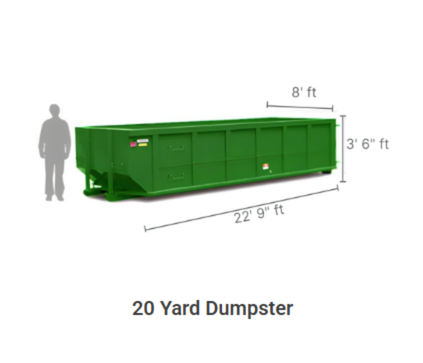
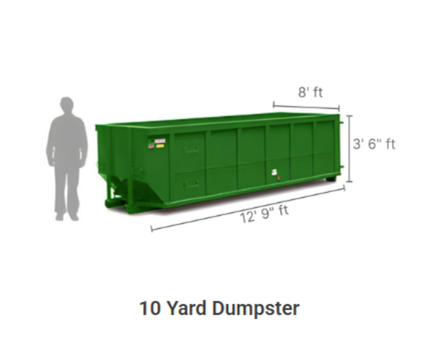
Dumpster sizes describe volume in cubic yards, so a 20 yard container holds 20 cubic yards of material. For a mental picture, one cubic yard is about the size of a standard washing machine, and a full size pickup bed holds roughly two cubic yards. That means a 10 yard container equals about five pickup loads, a 20 yard about ten, and a 30 yard about fifteen.
The footprints matter for planning your driveway space. A typical 10 yard runs about 12 feet long and 8 feet wide with sides around 3.5 feet tall, low enough to toss debris over the wall. The 20 yard stretches to roughly 22 feet long with 4 foot sides, and the 30 yard keeps that same footprint but rises to about 6 feet tall. All of them need overhead clearance for delivery, so wires and branches above the drop spot count too.
Matching containers to common Winchester projects
The 10 yard is the right call for a garage or basement cleanout, a bathroom remodel, carpet and flooring removal from a few rooms, or a small deck teardown. It is also the workhorse for heavy material like concrete, brick, or dirt, which we will explain in a moment. The 20 yard steps up to kitchen remodels, roof tear offs on typical homes, siding and window replacements, large basement cleanouts, and estate cleanouts in smaller houses.
The 30 yard is for volume: new construction, additions, whole home cleanouts, major demolition, and big commercial jobs. Contractors around Winchester often keep a 30 on site for the length of a build and have us swap it as it fills. If you are staring at a project and genuinely cannot decide between two sizes, count on debris expanding once it is torn out. Demolition material never packs as tight as it sat in the wall.
Weight limits matter as much as volume
Every rental includes a weight allowance, commonly two to four tons depending on the container, and going over adds a per ton overage charge at the landfill scale. For household junk and renovation debris, weight rarely becomes an issue before the container fills. Dense materials flip that math completely: concrete, brick, block, dirt, asphalt, and roofing shingles all hit weight limits long before they hit the rim.
That is why heavy material belongs in smaller containers. A 10 yard filled with concrete already weighs more than most trucks can legally haul, which is the real reason no hauler will let you load a 30 yard with masonry. If your project mixes heavy and light debris, tell us when you order. Sometimes the smart move is one small container for the dense material and one larger one for everything else.
What dumpster rental costs in the Winchester area
For typical week long residential rentals around Winchester, a 10 yard generally runs in the range of $300 to $400, a 20 yard $375 to $500, and a 30 yard $450 to $650, with the included weight allowance built into the price. Prices vary with debris type, total weight, rental length, and delivery distance, so treat those numbers as a realistic ballpark rather than a quote.
The bigger point is how the math plays out in practice. The jump from one size to the next is usually $75 to $150, while a second delivery of a small container costs a full rental fee. That asymmetry is why the size up when unsure rule exists. A slightly roomy container costs a little extra. An overflowing one costs a second haul and a project delay.
Bottom Line
Match the container to the project: 10 yard for small cleanouts and heavy masonry, 20 yard for most renovations and roofs, 30 yard for construction and whole home jobs, and size up whenever you are on the fence. Volume fills faster than people expect and weight limits rule the dense materials. If you would rather just describe your project and have someone pick for you, that is literally what we do all day. Call D&M Container Service and we will get the right size roll off headed to your Winchester driveway.
Related reading: How Much Does It Cost to Rent a Dumpster in Virginia


